

First published 2015. Fully re-reported, fact-checked and expanded — last updated 1 August 2026. All product links and images verified on that date.
It is not a big secret that crocodile leather has been a highly sought after one. With its stylish flair and natural luxury look, it is simply one style that men who REALLY know fashion cannot do without. Whether you are a businessman or not, the professional and timeless fashion clout that comes with crocodile briefcases is simply priceless. From the hardware, to the handle, to the convenient compartmentalized sections — to sum it up, convenience and style are exactly what the crocodile briefcase offers.
The wardrobes of men around the world have been refined with such an intricate and high quality item. The way forward in men’s luxury is to stick to timeless, vibrant and exclusively attractive patterns, such as the crocodile.
What’s in this guide
- 1. The luxury item you are supposed to use
- 2. Why brown does the most work
- 3. The briefcase, with alternate views
- 4. What to check before buying a daily carry
- 5. What actually goes in it
- 6. How it should look in year five
- 7. Where it goes across dress codes
- 8. Daily-use care
1. The luxury item you are supposed to use
It remains true that some luxury items aren’t meant to be used regularly. But in the case of briefcases, especially in a technology fueled era, having something handy, stylish and high quality available for your daily use is essential. The crocodile leather briefcase does nothing short of wonders for your style, and is a quick and easy way to claim your fashion sense as being on par with style trends of briefcases and luxury backpacks now and into the future.
That distinction is worth pausing on, because it changes what you should buy. A watch kept in a box and a bag carried five days a week are not the same purchase. The bag will be set down on floors, packed into car boots, rained on, and opened several times a day, and the things that matter in that life are not the things that matter in a display case.
Chart 1 — Occasional piece versus daily carry
| Occasional / statement | Daily carry | |
|---|---|---|
| Colour | Black, or a bold finish | Brown — hides wear, works with more |
| Finish | High gloss | Matte or lightly glazed; gloss shows every scuff |
| Hardware | Decorative | Solid brass or stainless, minimal moving parts |
| Structure | Rigid, holds a silhouette | Structured but with some give |
| Lining | Whatever looks best | Suede or cotton twill with a padded laptop sleeve |
| Repairability | Rarely tested | Essential — lining and edges will need work |
| What ruins it | Storage damage | Corner abrasion and handle-root failure |
The practical test: if you would hesitate to set the bag on a train floor, it is not your daily briefcase. Buy the one you will stop thinking about.
2. Why brown does the most work
The truth is, it is all too common for so-called fashion fads to come in and out of style on a whim, leaving men miserable with way too many options, not to mention vulnerable. The guesswork has been taken out for you, and one amazing style pushed to the forefront of modern day fashion collections.
Brown is the answer for a bag in daily use, for three reasons that have nothing to do with taste. It pairs with navy, grey, olive, stone and denim, where black is effectively restricted to charcoal, navy and black. It hides scuffing, because abrasion on brown leather lightens toward a tone the bag already contains, while abrasion on black leather shows grey. And it improves rather than degrades, since the oils from handling darken the grain at the handle and flap over the first year.
Black remains correct for business formal and evening, which is exactly why a black case is the second bag rather than the first. Our full crocodile briefcase guide covers the species and construction side in depth.
3. The briefcase, with alternate views
Men who are passionate about something, and always on the go, are the risk takers of today and tomorrow. Staying true to yourself means embracing your own character and staying comfortable in the right apparel. The crocodile briefcase man has a certain style, a certain way of thinking. His outlook is modern and vibrant, but never lets go of the rules of traditional men’s style. Knowing what he wants and where he’s going is imperative.
Yes, this brown crocodile briefcase is the signature of quality and style, which also meets passion and character.

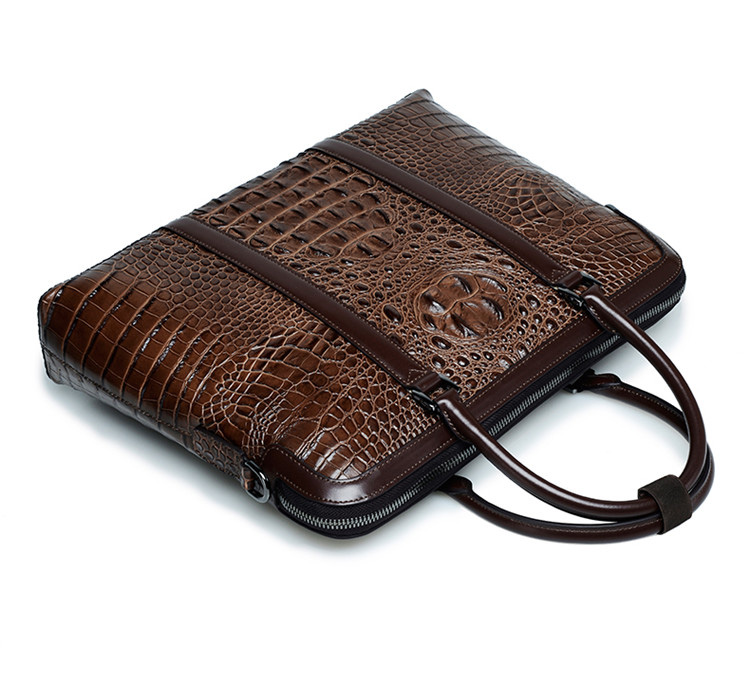
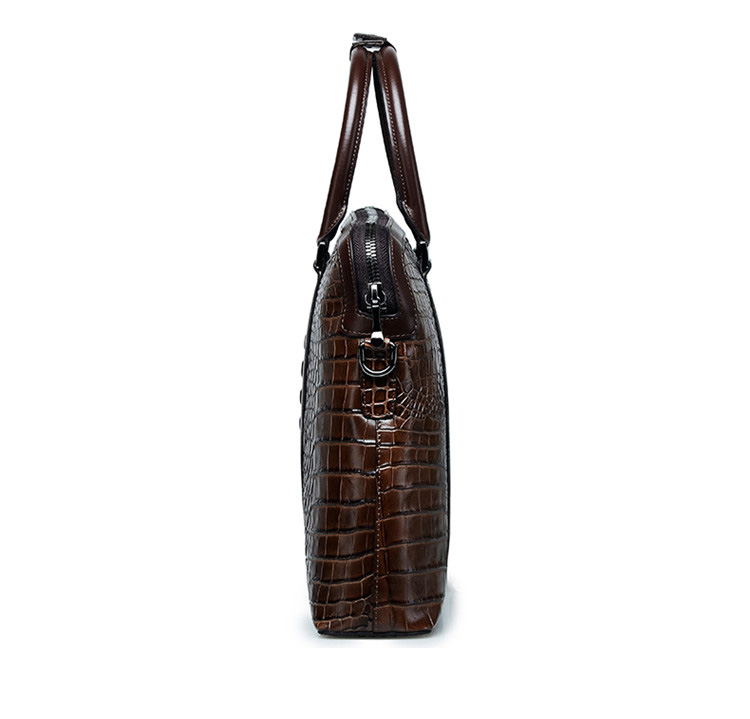
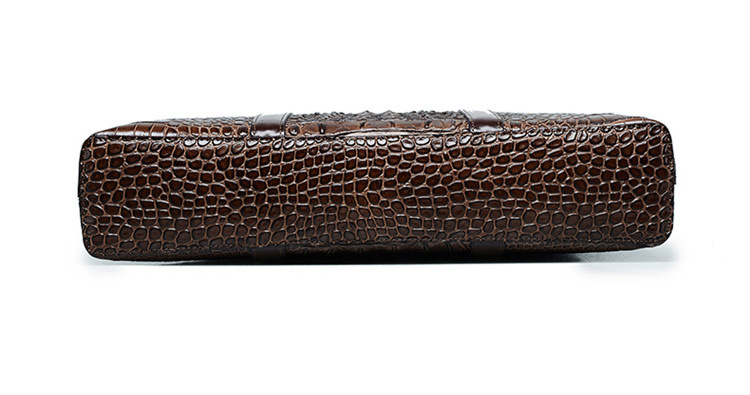
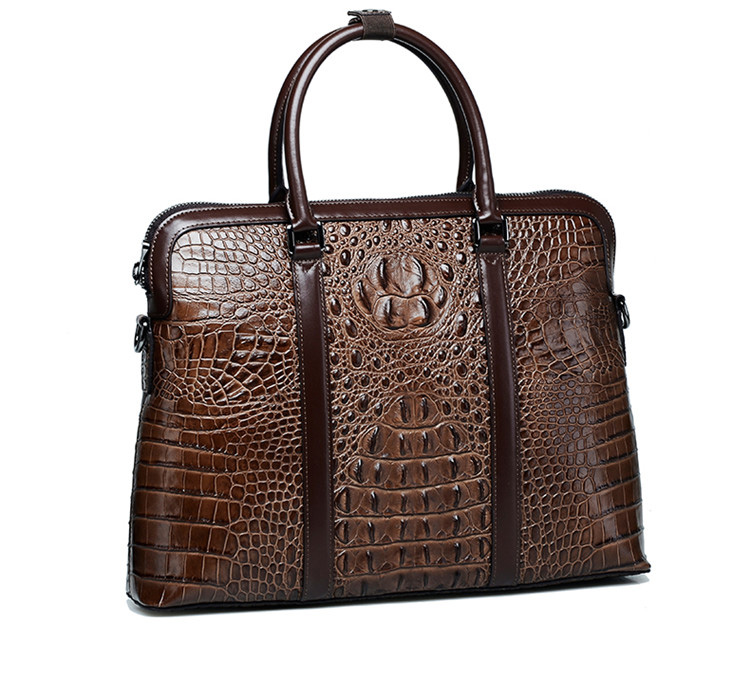
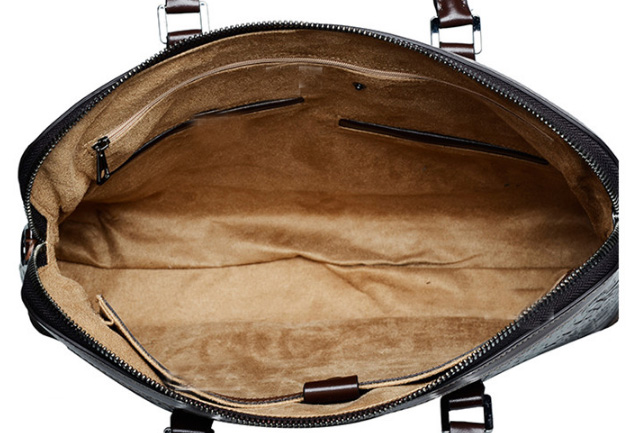
See this brown crocodile leather briefcase here at PILAEO.
What to look at: the handle root in view three and the base corners in view six. On a bag carried every day, those two points fail long before the leather does, and they are the honest measure of whether it was built for use or for display.
4. What to check before buying a daily carry
| Element | What good looks like | Walk away from |
|---|---|---|
| Leather grade | Full-grain or top-grain, named on the page | “Genuine leather” with no grade; bonded leather |
| Stitching | 7–9 per inch, box-X at handle roots | Wandering lines; no reinforcement where it matters |
| Edges | Turned and stitched, or several sanded coats | Raw cut edges; one thick glossy coat that chips |
| Base | Doubled leather or protective feet | Single layer that abrades through in a year |
| Hardware | Solid brass or stainless | Plated zinc that chips grey at the corners |
| Lining | Suede or cotton twill, padded laptop sleeve | Thin polyester that crinkles audibly |
Ask whether the hide came from a tannery certified by the Leather Working Group, whose audit covers water, energy, waste and restricted substances. It is an environmental standard rather than a quality grade, so treat it as a floor.
Chart 3 — Sizing reference
| Style | Length | Width (depth) | Height | Laptop fit |
|---|---|---|---|---|
| Compact | 11″ | 4″ | 14″ | 13″ |
| Standard | 13″ | 5″ | 16″ | 15″ |
| Travel | 14″ | 6″ | 18″ | 17″ |
| Messenger | 15″ | 4″ | 11″ | 14″ |
Measure your laptop’s diagonal, width and thickness, since a thin 16-inch machine often fits where a chunky 14-inch will not. Interior length must exceed 31 cm for A4 or Letter documents to lie flat. Keep the daily load under about four kilos, above which a hand-carried bag becomes a nuisance within fifteen minutes.
5. What actually goes in it
A briefcase carried every day is packed differently from one carried occasionally, and the difference decides how long it survives. The temptation with a good bag is to fill it because the space exists, but a briefcase should carry a day, not a week.
A laptop, a charger, a folio or notebook, a pen, and one personal item is the sensible ceiling. Add a water bottle and a change of clothes and you have moved into travel bag territory, which is a different purchase entirely and puts strain on seams that were never designed for it.
Keep the laptop against the back panel rather than loose in the main compartment. It sits the weight closer to your body, which makes the bag feel lighter over a long walk, and it stops a heavy machine pressing an outline into the front panel over months of carrying. On a patterned or textured leather that outline is particularly hard to remove once it sets.
Empty it properly at least once a week. Receipts, chargers and forgotten paperwork accumulate faster than anyone expects, and the weight creeps up without you noticing until the bag is uncomfortable and you blame the bag.
6. How it should look in year five
The measure of a daily briefcase is not how it looks new but how it looks after a thousand uses, and a good one improves on a predictable schedule.
In the first year the grain darkens where your hands land, at the handle and along the flap edge, so those areas deepen noticeably against the panels. This is oil transfer rather than dirt, and it is the single clearest sign that a bag is genuinely being used rather than stored.
By year three the base corners will show. That is where the bag meets desks, floors, car boots and train luggage racks, and it is unavoidable on anything carried daily. On a well made case the corner reinforcement takes that abrasion and the silhouette holds; on a poorly made one the corner softens and the whole bag starts to slump.
By year five, expect the lining to be the weakest part rather than the leather. Lining replacement is a routine repair at any competent leather workshop, as is edge repaint, and both are what allow a good case to run for decades rather than being replaced. A bag worth buying is a bag worth repairing, and that calculation is the real argument for spending more at the outset.
7. Where it goes across dress codes
| Dress code | Brown crocodile case? | Pair with | Avoid |
|---|---|---|---|
| Black tie | No | — | Any handled case breaks the line |
| Business formal | Only with brown shoes | Navy or grey worsted, dark brown oxfords | Black shoes with a brown bag |
| Business professional | Yes — the natural habitat | Navy blazer, grey trousers, monk straps or loafers | Matching bag and shoes exactly |
| Smart casual | Yes | Knitwear, chinos or dark denim, Chelsea boots | One exotic texture too many |
| Travel | Yes | Overshirt, chinos, clean leather sneakers | Overloading past four kilos |
| Evening | Prefer black | Dark suit, no tie | Brown at a formal evening event |
One exotic at a time. A crocodile briefcase with crocodile shoes and a crocodile watch strap is a costume. Let the bag be the texture and keep everything else plain. For shirting underneath, see How to Wear a Men’s Button Down Shirt.
8. Daily-use care
| Frequency | Action | Notes |
|---|---|---|
| After each use | Wipe with a dry cloth, following the scale direction | Never against the scale edge — it lifts the tips |
| Weekly | Empty completely, air the interior two hours | Daily carry traps far more moisture than occasional use |
| Every 3–6 months | Reptile-specific conditioner, thin coat | Cowhide creams are too heavy and dull the gloss |
| Every 6 months | Inspect handle roots, base corners, edge paint | The two failure points on a bag in daily use |
| If soaked | Blot, stuff with paper, dry at room temperature | Never near heat — it shrinks and cockles the scales |
| Storage | Cotton dust bag with acid-free tissue | Never plastic |
A bag in daily use should look used. Corner wear on an otherwise sharp case reads as character rather than damage, and lining replacement and edge repaint are both routine repairs that keep a good case going for decades. The Victoria & Albert Museum holds significant collections of historic leather goods that show how little the form has actually changed, and the Museum at FIT documents the same shift from utility object to status piece.
For the wider context of how men’s collections have moved, the arrival of a standalone American menswear showcase in New York marked the point at which men’s accessories stopped being an afterthought on the schedule.
Looking to dress the part? You can see crocodile briefcases at PILAEO.
Read more: Missoni History Revisited
Read more: Briefcase Guide For Modern Men
Read more: 3 Ways The Crocodile Briefcase Is Changing Men’s Fashion
Read more: Why Men Are Clamoring To Get Crocodile Wallets
Explore How to Wear a Men’s Button Down Shirt
5 Ways A Brown Crocodile Briefcase Transforms A Professional Wardrobe
- Single Statement That Justifies Surrounding RestraintA crocodile briefcase carries enough visual weight that the rest of the outfit can stay subdued. Quiet suits and ties let the briefcase do the talking.
- Bridges Formal And Smart-Casual ContextsBrown crocodile works equally well with a charcoal three-piece suit and with navy chinos plus a cashmere knit. Few accessories span this range.
- Hardware Tone Compounds The StatementAntique brass or aged gold hardware complements brown crocodile better than chrome. The warm metal carries through to watch and belt buckle choices.
- Pairs With Mid-Tone TailoringBrown crocodile reads best against charcoal, navy, and oxford-blue suits. Avoid full black tailoring which clashes with the warm brown undertone.
- Appreciates As A Collectible ObjectAuthentic crocodile briefcases from established luxury houses hold value and can be resold or passed down. Few work accessories appreciate over time.
Frequently asked questions
Should a luxury briefcase be used every day or saved for occasions?
Used. Some luxury items genuinely are not meant for regular use, but a briefcase is not one of them, particularly in a technology fuelled era where you need something handy, stylish and high quality available daily. The practical test is simple: if you would hesitate to set the bag down on a train floor, it is not your daily briefcase. Buy the one you will stop thinking about.
Should my first briefcase be brown or black?
Brown, for three reasons that have nothing to do with taste. It pairs with navy, grey, olive, stone and denim, where black is effectively restricted to charcoal, navy and black. It hides scuffing, because abrasion on brown lightens toward a tone the bag already contains while abrasion on black shows grey. And it improves with handling as oils darken the grain. Black remains correct for business formal and evening, which is why it makes a better second bag than a first.
What is different about buying a briefcase for daily use?
Almost everything except the leather. A daily carry wants a matte or lightly glazed finish rather than high gloss, which shows every scuff. It wants solid brass or stainless hardware with minimal moving parts, a suede or cotton twill lining with a padded laptop sleeve, and a doubled base or protective feet. Above all it needs to be repairable, because the lining and edges will need work long before the leather does.
What should I check before buying?
Six things. Leather grade should be named as full-grain or top-grain rather than the vague term genuine leather. Stitching should run seven to nine per inch with box-X reinforcement at the handle roots. Edges should be turned and stitched or painted in several sanded coats. The base should be doubled leather or have feet. Hardware should be solid brass or stainless rather than plated zinc. Lining should be suede or cotton twill with a padded laptop sleeve.
What size briefcase do I need?
Measure your laptop's diagonal, width and thickness, since a thin 16-inch machine often fits where a chunky 14-inch will not. Interior length must exceed 31 cm for A4 or Letter documents to lie flat. A standard case runs roughly 13 by 5 by 16 inches and takes a 15-inch laptop. Keep the loaded weight under about four kilos, above which a hand-carried bag becomes a nuisance within fifteen minutes.
How much should I put in a briefcase?
A day, not a week. A laptop, charger, folio, pen and one personal item is the sensible ceiling. Adding a water bottle and a change of clothes moves you into travel bag territory and puts strain on seams never designed for it. Keep the laptop against the back panel rather than loose, which sits the weight closer to your body and stops a heavy machine pressing an outline into the front panel over months.
How will a daily briefcase look after a few years?
It should improve on a predictable schedule. In the first year the grain darkens at the handle and flap edge where your hands land, which is oil transfer rather than dirt. By year three the base corners will show wear, since that is where the bag meets floors and car boots. By year five the lining is usually the weakest part rather than the leather, and lining replacement and edge repaint are both routine repairs that keep a good case running for decades.
Can I wear a brown briefcase with black shoes?
Not in a business formal setting, which is the one hard rule in this area that survives scrutiny. In business professional and smart casual contexts, aim for tonal harmony rather than an exact match, since a chocolate case with mid-brown shoes reads considered while a perfect match reads like a gift set. One shade apart is the target.
How do I care for a crocodile briefcase in daily use?
Wipe with a dry cloth after each use, following the scale direction rather than against the scale edge, which lifts the tips. Empty and air the interior weekly, since daily carry traps far more moisture than occasional use. Apply a reptile-specific conditioner in a thin coat every three to six months, as cowhide creams are too heavy and dull the gloss. Inspect handle roots, base corners and edge paint every six months.
What if my briefcase gets soaked?
Blot rather than rub, stuff it with paper to hold the shape, and dry it at room temperature well away from any heat source. Condition only once it is fully dry. Heat is what causes permanent damage, shrinking and cockling the scales in a way that cannot be reversed, so never use a radiator, hairdryer or hot car to speed the process up.
